Open-source Community edition
VolEq — Volume Equilibrium
Automatic voice-volume leveling for online meetings.
Early release
Read the current release notes and known issues before installation. In v0.1.0, denying System Audio Recording access can incorrectly enter a muting capture path; stop or quit VolEq to restore the original path. The owner has also reproduced a full-system-sleep failure where VolEq appears active but produces no sound; stop and restart it.
Fixes described in the repository’s unreleased 0.1.1 source are not shipped or owner-validated release behavior yet.
Clearer speech, calmer meetings
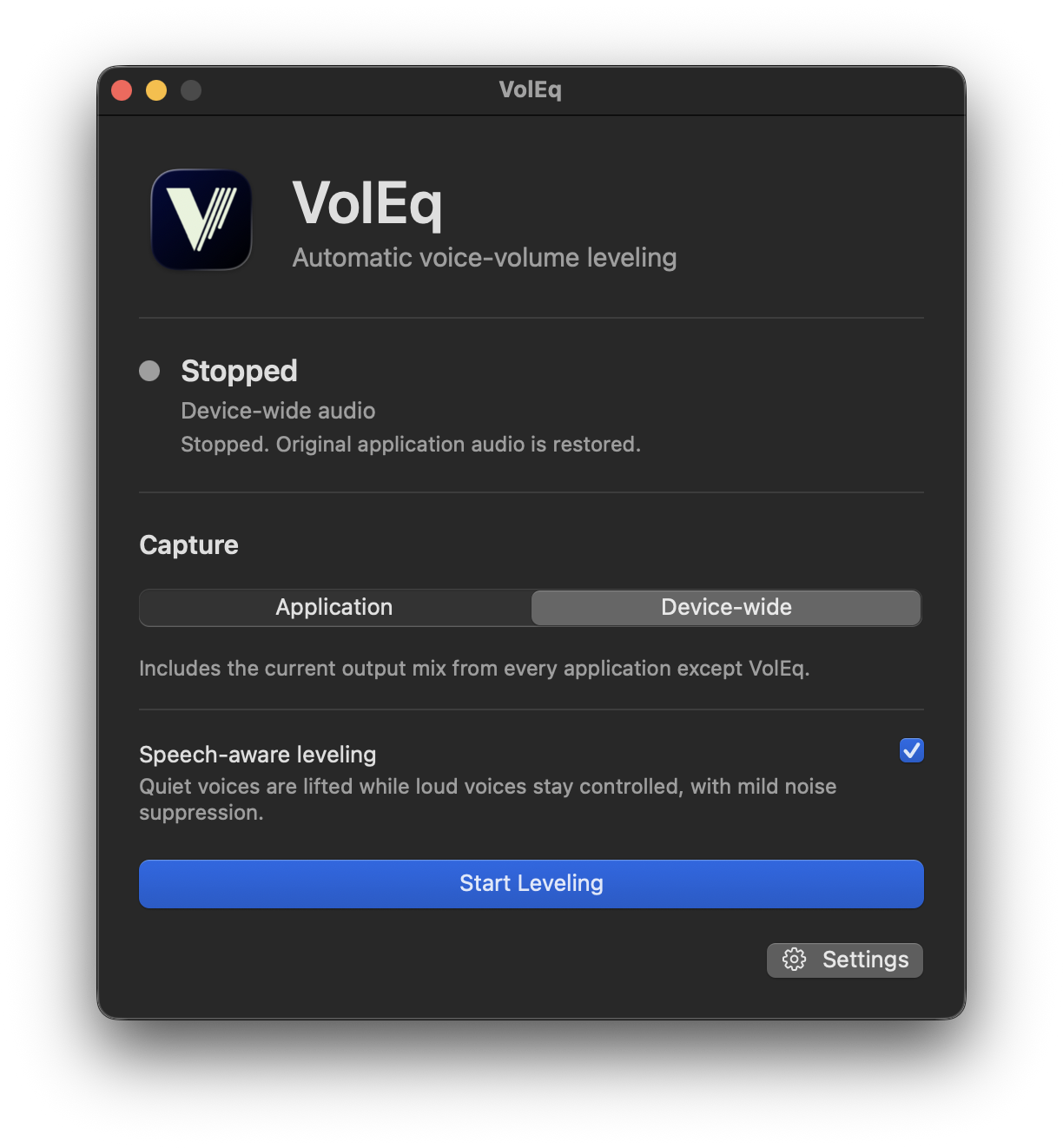
VolEq raises quiet speech and controls loud speech while keeping the captured stream’s stereo relationship intact. Its speech-aware path helps prevent music and unrelated sounds from receiving quiet-voice gain and can apply mild noise suppression while speech and background noise are both detected.
Two capture modes
Choose one active application or the complete device-wide output mix.
Local processing
Captured audio is processed locally in memory, without accounts or telemetry.
Speech-aware leveling
Bundled RNNoise states and Apple’s offline SoundAnalysis guide local decisions.
Open source
The complete Community application is available in the public repository.
Current boundaries
- VolEq processes the combined captured mix. It does not maintain independent per-participant controls or persistent gain profiles.
- The official current binary supports Apple Silicon only; Intel Macs are not supported.
- The current application is available only for macOS, even though the longer-term product concept is not restricted to one desktop platform.
- Only mono or stereo 32-bit floating-point PCM layouts are supported.
- Only applications currently producing audio appear for application capture.
- Singing may be classified as speech and receive leveling or mild suppression.
Compatibility claims are limited to the public release evidence. The repository keeps automated checks, documented compatibility, and owner-run physical listening evidence distinct.